Adapted from a lecture by Robert Eskridge
titled “Exploration and the Cosmos: The Consilience of Science and Art.”
Science and
art naturally overlap. Both are a means of investigation. Both involve ideas, theories,
and hypotheses
that are tested in places where mind and hand come together—the laboratory and
studio. Artists, like scientists, study—materials, people, culture, history,
religion, mythology— and learn to transform information into something else. In
ancient Greece, the word for art was techne, from which technique and technology
are derived—terms that are aptly applied to both scientific and artistic
practices.
Art and
Scientific Investigation in Early-European Art
Leonardo da
Vinci, painter and draftsman of the High Renaissance,
is best known as an artist whose works were informed by scientific
investigation. Leonardo observed the world closely, studying physiology
and anatomy
in order to create convincing images of the human form. He believed that the moral
and ethical
meanings of his narrative paintings would emerge only through the accurate
representation of human gesture and expression. For this Christian
artist, science and art were different paths that led to the same destination—a
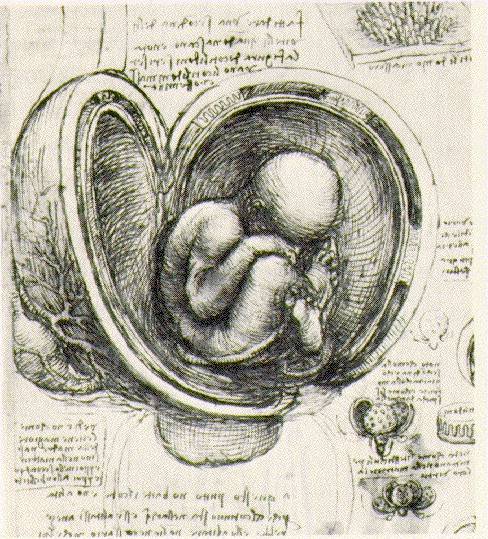
higher spiritual truth. His Sketch of
Uterus with Foetus (c. 1511–13) is one of several thousand drawings
he produced in his lifetime in which artistic and scientific investigations are
bound together. These extraordinary drawings are revered as examples of the
Renaissance concept of the integration of all disciplines.
The
Astronomer (1668) by Dutch painter Johannes Vermeer is another
example of the profound connection between science and art. The people of
17th-century Netherlands had an exploratory spirit. Equally interested in this
world and the larger universe, the familiar and the exotic, they were intent on
looking and investigating. It was here in the early 17th century that the microscope
and telescope
were first developed. Vermeer’s painting celebrates an astronomer. Yet it
equally celebrates the work of artists and the materials of this world. The
painting hanging on the back wall was created by a local artist; the Middle Eastern
carpet on the table was crafted by a foreign artist; Vermeer’s own paints
(ground mineral pigments
mixed with linseed oil) and brushes were produced by local artisans.
The globe at which the astronomer gazes evidences the link between science and
art most pointedly, for it demonstrates this astronomer’s—and his culture’s—combined
interest in finely crafted objects and scientific systems, such as cartography
and astronomy.
The Science
of Color in 19th-Century Painting
In the
late-19th and early-20th centuries, the physiological, psychological,
and phenomenal
effects of color and light were of primary concern to Impressionist
and Post-Impressionist
artists such as Edgar Degas
(1834–1917), Vincent van Gogh (1853–1890), Auguste Renoir (1841–1919), Paul
Gauguin (1843–1903), and Claude Monet (1840–1926). Considered by
many to be the greatest nature painter in modern-art history, Monet suggested
that our sense of our physical environment changes continuously with our
shifting perceptions of light and color. In On the Bank
of the Seine, Bennecourt (1868), a painting of his wife-to-be, Monet
captures a fleeting “impression” of the landscape through loose brushwork and composition.
His impression is pre-cognitive—before
the mind labels, identifies, and converts what it sees into memory. Tellingly,
the woman in the painting looks not at the house and trees across the river,
but down at their wavering, upside-down reflections in the river, a perspective
that echoes the process of perception
itself. Images in the form of light enter the eye, an orb with a
nerve-sensitive background. As light penetrates, it is inverted and projected
onto the back of that light-sensitive orb, where the brain processes the
information. Monet’s painting captures the vibration between impression and
perception—the contingent
moment. It conveys a sense of trembling as the light and color of the landscape
shift and time passes.
A number of
years after Monet’s Bennecourt, Georges Seurat began painting A Sunday on La
Grande Jatte—1884 (1884–1886) (above). As an art student at the Academy of Fine
Arts in Paris, he studied the physics of color, and this enormous painting is
an exercise in color theory. Unlike Renaissance
and Dutch artists, Seurat and Monet did not mix their own paint. They benefited
from breakthroughs by French chemists in the early 19th century who had
invented both premixed paints packaged in tubes and synthetic
pigments, such as ultramarine blue, which previously had been made from ground lapis lazuli
and was, therefore, the most expensive pigment. Neither Seurat nor Monet, with
little money in their pockets, could have created their blue-filled,
experimental works without the scientific breakthroughs earlier that century.
Using these
new paints, Seurat invented a technique called Pointillism
to investigate how adjacent colors blend when taken in by the eye. Up close,
the surface of his painting contains thousands of painted dots and dashes, discrete
areas of color. But Seurat placed these dots of complementary
colors next to each other—purple and yellow, orange and blue, green
and red—so that at a distance they interact to create vibrant blended colors
and larger, whole forms. Carrying his scientific approach to color theory to
the edges of the image, Seurat represented the range of the visible
spectrum in the painting’s border dominated by red and blue.
20th-Century
Art and Science
Pablo Picasso's
(1881–1973) portrait of art dealer Daniel-Henry
Kahnweiler (1910) combines Monet’s ideas about the contingency of
time and Seurat’s theory about the perception of discrete elements. Here,
Picasso breaks up the figure and objects
in his
composition in the style known as Cubism.
Instead of rendering his subjects as distinctly recognizable forms, he paints
them from several points of view. Kahnweiler’s head, suit, watch fob,
and hands, as well as the still life
to the left and the decorated wall behind, remain identifiable, but these
elements have been broken up into flattened planes and rearranged across the
picture surface. Painted just a few years after Albert
Einstein put forth his theory of relativity, which asserts the
contingent nature of observing reality, Picasso’s work similarly illustrates
the elusive presence of his subject—Mr. Kahnweiler. Picasso’s Cubist painting
style, like studying Einstein’s scientific theory, requires careful analysis,
but it rewards the viewer’s effort with perception and understanding.
The invention
of photography in the middle of the 19th century was a technological
wonder—artistically and scientifically. The practice of oxidizing
and fixing images on light-sensitive paper or a metal plate posed a great
challenge to painters, who had historically been charged with the task of
providing their culture with images of itself and the world around them. People
believed this new medium could represent the world accurately and more quickly.
Ansel Adams (1902–1984) one of the most extraordinary photographers of the
North American landscape, used his camera to capture the spirit and beauty of
the American West. His majestic vistas of mountains and rivers, such as The Tetons
and the Snake River, Grand Teton National Park, Wyoming (1942),
embraced the bond between man and nature while recording with astonishing
technical accuracy the phenomenal effects of light and atmosphere.
Today,
light-and-space artist James Turrell seeks to link the terrestrial and
celestial realms in his work at Roden Crater,
a natural cinder volcano situated on the southwestern edge of the Painted
Desert in northern Arizona. Since 1972, Turrell has been transforming the
crater into a large-scale artwork by subtly manipulating and reshaping its
form. Like Renaissance
artist Leonardo da Vinci did, Turrell uses his knowledge of engineering,
and, like Seurat and Monet, he employs his knowledge of the effects of light
and space. When Turrell completes his gigantic project, visitors standing in
the middle of the crater on the reflective material with which the artist has
lined it will feel suspended between the sky and earth.

Imagery produced at Princeton University in the course of research or
incorporating tools and concepts from science. That's a picture of some
kind of crystal thingy.
There has
long been a connection between art and science, one that can be traced back to
the Egyptian pyramids. History
proves that the two disciplines cannot exist without each other, enduring in
constantly changing and evolving relationships.